
Since 2016, KnowYourStuffNZ has provided drug-related harm reduction services at events around New Zealand, including drug checking. Each year, we collate our results across the event season to analyse:
- what substances people thought they had,
- what substances people actually had, and
- what decisions people made about taking the substances
KnowYourStuffNZ Activity 2023-24
This season’s data covers the period from 1 April 2023 to 31 March 2024. KnowYourStuffNZ was at 171 events during this period and tested a total of 4625 samples.
For comparison, we have tested the following numbers of samples across all years since 2016:
| Year | Samples | Events |
| 2016-17 | 330 | 9 |
| 2017-18 | 445 | 7 |
| 2018-19 | 805 | 13 |
| 2019-20 | 1,368 | 22 |
| 2020-21 | 2,744 | 27 |
| 2021-22 | 1,611 | 40 |
| 2022-23 | 3,800 | 104 |
| 2023-24 | 4,625 | 171 |
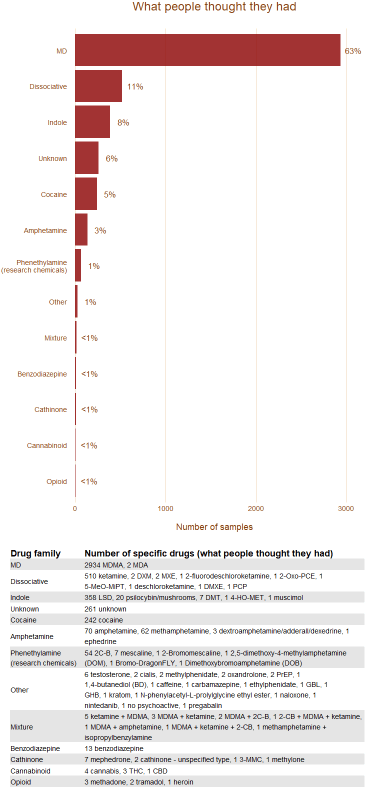
What drugs did people think they have
The substance most commonly brought to us was presumed to be MDMA. Dissociatives (such as ketamine) were second, while indoles (such as LSD or psilocybin/mushrooms) were the third most common.
This is consistent with previous years. The proportions of families of other substances people thought they had are also consistent with last year. Note that some substances commonly used at events are not tested. We don’t need to test alcohol as it is a regulated drug with a safe supply. Cannabis or other plant materials are difficult for us to test with the equipment we have.
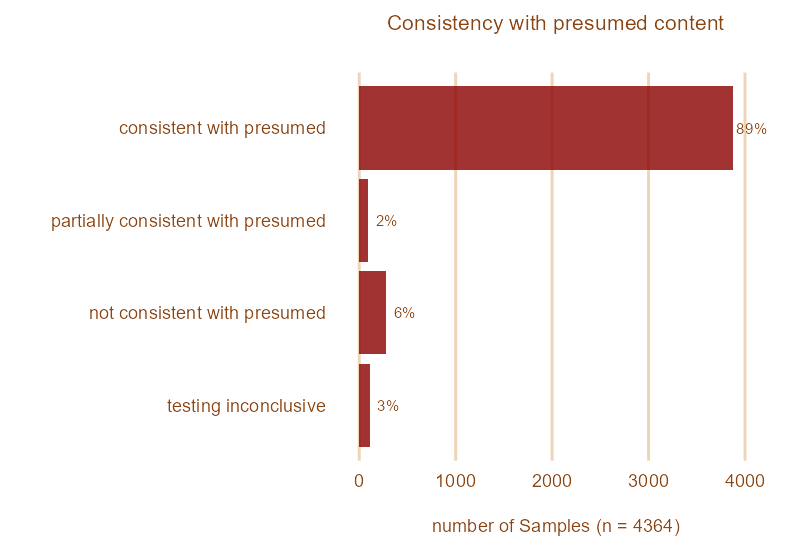
How often were substances what people thought they were?
89% of the substances tested consistent with what clients thought they had. This is slightly more than last year’s 86%.
6% of samples were not consistent with what clients thought they had. 2% of samples were partially consistent with what clients thought they had. These samples usually contained the presumed psychoactive plus additional psychoactives, or non-psychoactive substances that can cause harm.
In a few cases, the client thought they had a mix of two psychoactive substances, but the sample actually contained only one. Testing was inconclusive for the remaining 3% of samples.
Note that this analysis does not include samples brought to us as unknown.
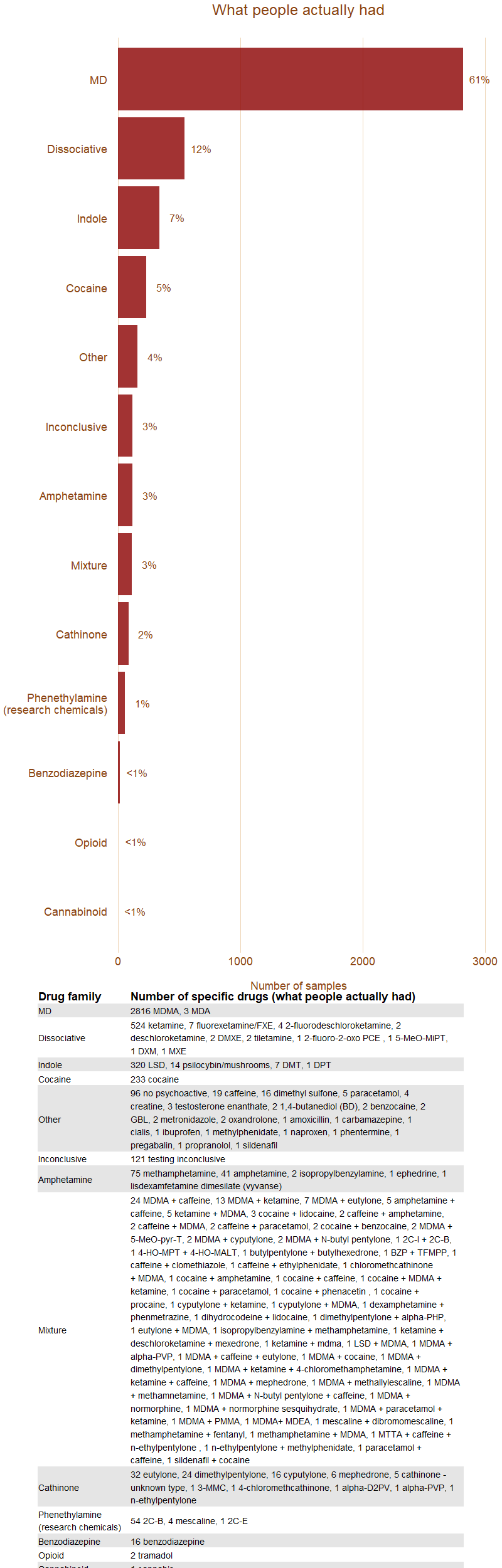
What did people actually have?
What we found in our testing
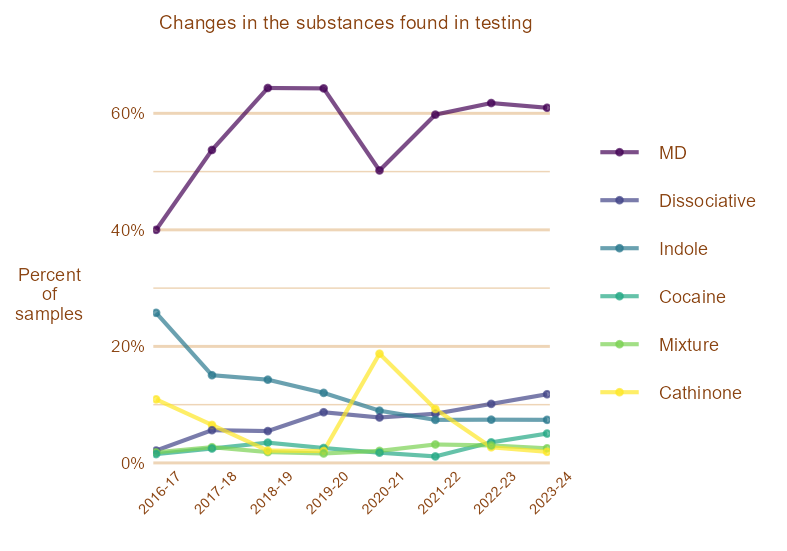
The most common substance found was MDMA, which represented more than half of the substances. The next most common were dissociatives (largely ketamine) and indoles (largely LSD).
Alpha D2PV was found at two of the three New Years Eve festivals we attended and continued to be found through the summer until February. It was mis-sold as MDMA in both the North and South Islands. Alpha D2PV is a high risk synthetic cathinone which has caused hospitalisations in Aotearoa and overseas.
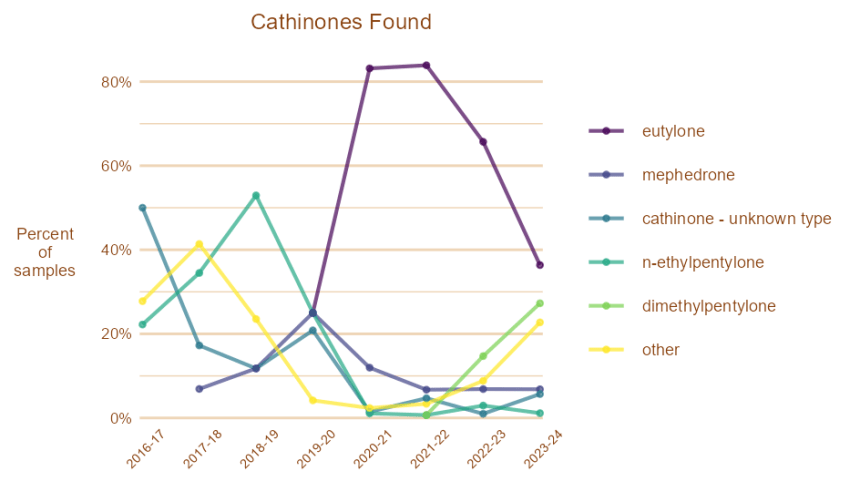
Cathinones represented 2% of the substances found (a total of 88 samples, not counting where they’ve shown up as a mix with another substance). This continues the significant drop in the amount of cathinones found from its peak of 20% in 2020-21.
Eutylone remains the most commonly found cathinone (36% of cathinones). This year we saw a distinct increase in dimethylpentylone.

High dose MDMA pills
This season we found 138 pressed pills that we estimated to contain two or more doses of MDMA (at least 150mg). These pills made up 4.9% of the MDMA that we found. Last year we found 86 high-dose MDMA pills, which was 3.7% of the MDMA that we tested.
Pressed pills remain a challenge to test due to the high proportion of non-psychoactive fillers used to manufacture the pills. Caffeine was a common cutting agent in MDMA pressed pills. Press pill weights ranged from about 150mg up to over 1g. the majority of this being fillers.
How did testing influence people’s decisions?
When the substance was what they thought it was, 94% of clients said they would take it.
When the substance was not what they thought it was, 47% said they would not take it, and only 33% of clients would likely take the substance.
When the substance was partially consistent, 63% of clients said they would take it, and 15% said they would not take it.

Why did people choose to take a substance when testing showed it was not what they thought it was?
We asked people why they would take a substance when it wasn’t what they thought it was.
We found that:
- 51% (27 people) said that they intended to take it because they considered the substance to be desirable. Most of these were cases where testing showed that the substance was MDMA, ketamine or cocaine.
- 21% (11 people) said that they intended to take it because they had consumed it before without problems.
The remaining 28% (15 people) gave other reasons, including:
- curiosity, or wanting to try a small amount,
- inability to source anything else,
- not wanting to waste money, and
- uncertainty on the validity of test results.
People find some substances more desirable than others. We collated our results for samples that were not as presumed across all years of operation and found that people’s intention to take or not take a substance is highly dependent on the type of substance found.69% of people won’t take substances that turn out to be cathinones, and 70% won’t take substances where the test was inconclusive.
In contrast, 60% or more of people said they would take the substance if it was cocaine, a dissociative, an opioid, an indole, or in the MD (mostly MDMA) family as these are seen as desirable.
Broadly speaking, the more high-risk the class of substance, the higher number of people state that they will not take the substance.
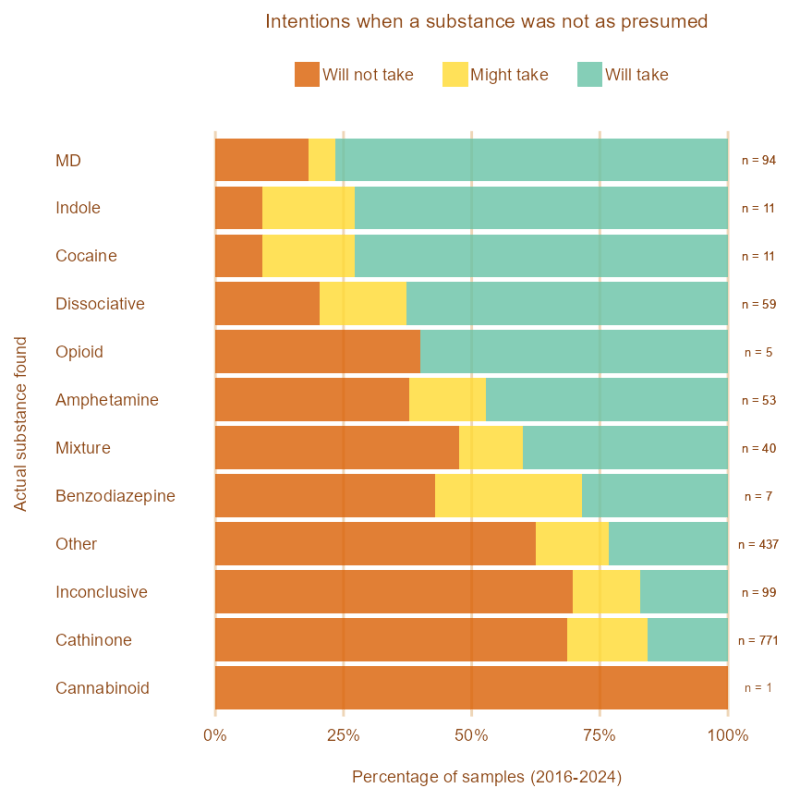
Change over time in whether people say they will take a substance when it’s not what they thought
The number of people stating they will not or might take a substance when it’s not what they thought it was has slightly decreased since last season.
The largest number of people saying they would not take the substance was in 2020-21, when there was a large amount of eutylone found instead of MDMA.
Whether people state they will or will not take a substance when it isn’t as presumed fluctuates year on year, and may be due to factors such as the risk profiles of different substances, public perception on harm of certain drugs, or random fluctuations in clientele.

How did people intend to take substances?
Different consumption methods are associated with different risks. Clients are asked how they intend to consume a substance so we can provide them with the correct harm reduction advice.
- 61% of clients said that they intended to take their substance orally or sublingually (under the tongue)
- 26% said that they intended to snort it
- 13% said that they were unsure about whether they would take it orally or snort it, or said that they would use other methods (smoking or vaporising the substance, inserting it rectally or injecting the substance)
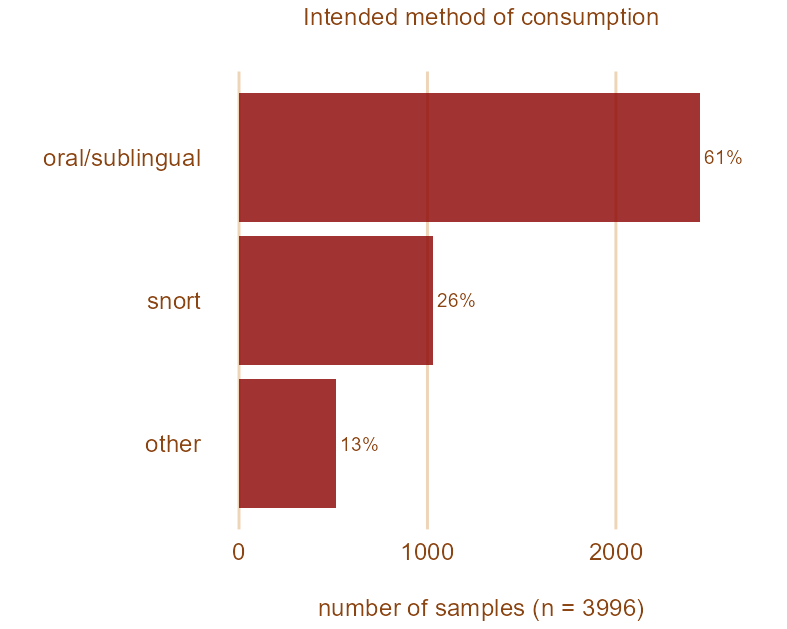
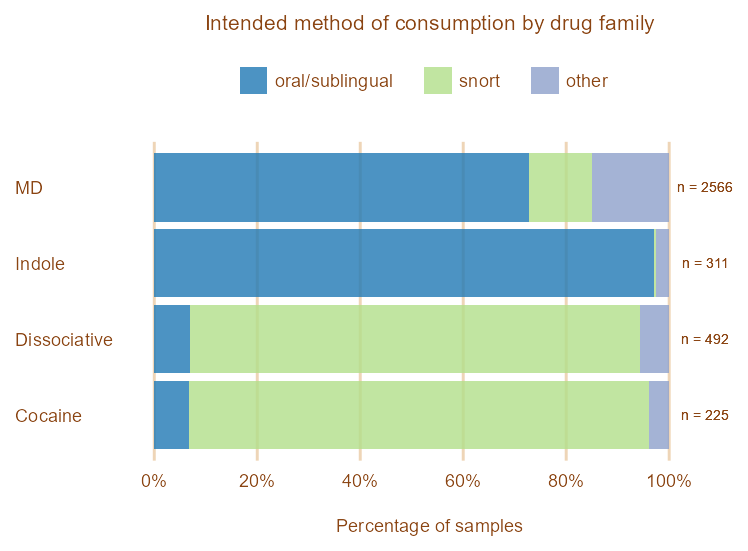
We advise clients that oral/sublingual is the safest route of administration for MDMA. Other substances, such as ketamine and cocaine, are most commonly snorted. These results have remained consistent across years.
Are we seeing changes over time in the proportion of substances that are what people thought they were?
This season’s proportion of substances that tested as presumed (89%) is higher than the previous three seasons, and similar to the 2018-19 and 2019-20 testing years. These were followed by a low of 69% in 2020-21, when we saw widespread substitution of cathinones for MDMA.
| Year | % Consistent with presumed |
| 2016-17 | 68% |
| 2017-18 | 79% |
| 2018-19 | 87% |
| 2019-20 | 86% |
| 2020-21 | 69% |
| 2021-22 | 78% |
| 2022-23 | 86% |
| 2023-24 | 89% |
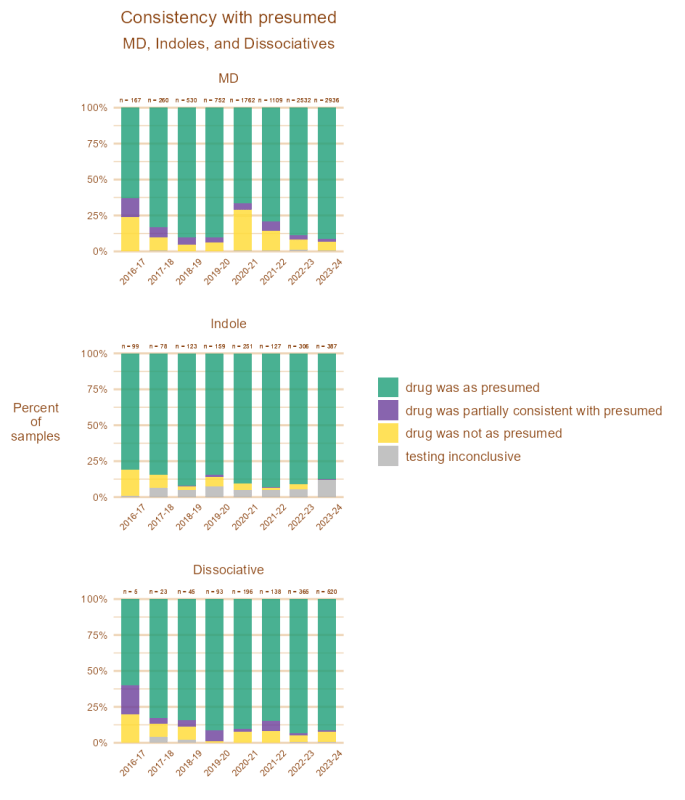
Change over time in the proportion of MD Family and Indole samples that were what they were thought to be
The proportion of MDMA that was actually MDMA has fluctuated over time but has been steadily increasing since the 2021-22 season and has returned to pre-2021 levels.
| Year | Consistent with presumed (MDMA) |
| 2018-19 | 90% |
| 2019-20 | 90% |
| 2020-21 | 66% |
| 2021-22 | 79% |
| 2022-23 | 89% |
| 2023-24 | 91% |
The proportion of indole and dissociative-type substances that are consistent with presumed has remained fairly stable across the past five years, with dissociatives ranging between 83% and 93% (91% in 2023/24) and indoles between 84% and 93% (88% in 2023/24) as presumed.
Note that the decrease in the proportion of MDMA that was ‘partially consistent with presumed’ probably results from improvements to our testing method between 2016/17 and 2017/18.
Are we seeing changes over time in the substances that people have?
MD-family substances (such as MDMA and MDA) remain the most commonly found substance in our testing. We have observed a small but steady increase in the number of dissociatives and cocaine found this year, and a slight decrease in the number of cathinones.
We continue to detect pressed pills with concerning mixtures or doses, including pills containing:
- A mixture of ketamine and Deschloro-N-ethyl-ketamine (rhino ket),
- synthetic cathinones, and MDMA
- Multiple doses of MDMA.
First detections and interesting data points
This year there were several notable detections of new psychoactive substances across the drug checking programme, including:
- Nitazenes
Nitazenes are a class of highly potent synthetic opioids, similar in potency to fentanyl. Nitazene variants have been detected across drug checking organisations since mid-2023 and have been sold as pharmaceuticals such as benzodiazepines or opiates (such as oxycodone). - Ketamine analogues
The ketamine analogue 2-Fluoro-2-Oxo-PCE, also called CanKet due to its first-ever detection in Canberra, was detected in the Wellington region. Ketamine analogues are structurally similar to ketamine but may have unexpected and unpredictable effects. - Alpha-D2PV
Alpha-D2PV was first detected in the Canterbury region being sold as MDMA in December 2023. This substance is a synthetic cathinone and is much more potent than MDMA, meaning people may accidentally take multiple doses. It has been implicated in deaths overseas.