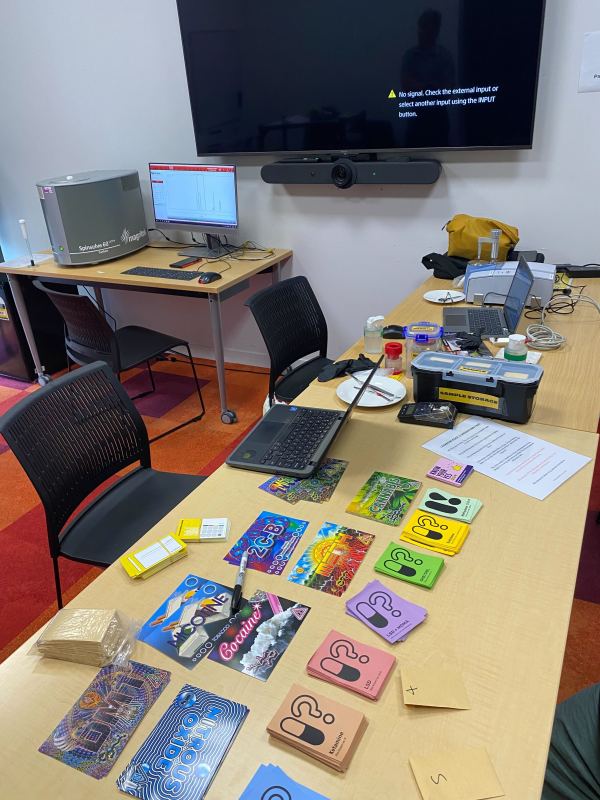
KnowYourStuffNZ (KYSNZ) and a team of researchers at Te Whare Wānanga o Waitaha | University of Canterbury (UC) and PHF Science are delighted to announce a new research project trialling an innovative method for testing the contents of illicit drug samples.
The trial uses Magritek’s benchtop Nuclear Magnetic Resonance (NMR) device and some advanced mathematical modelling to analyse samples presented to KYSNZ’s drug checking services in the Canterbury region.
Currently, in-field drug checking is done using infrared spectroscopy.
“This is still the gold standard for drug checking,” says Dr. Jez Weston, Deputy Manager at KYSNZ. “Infrared spectrometers are durable and portable, meaning we can set them up anywhere, and have reliable and high-quality results within minutes.”
However, drug checkers worldwide are always eager for upcoming technologies that can improve drug checking services.
NMR analysis has the potential to unlock further information about drug samples and may provide pathways to determine the quantity of a particular substance in a sample or be able to detect more complex mixtures or trace amounts of substances.
“This trial is significant because we will have to process real samples, with limited quantities of material, and limited laboratory facilities. It is a critical step towards determining whether the technology can be implemented in the field,” said Professor Daniel Holland, from the Department of Chemical and Process Engineering at UC.
UC PhD student Shallu Verma has been working over the past 3 years to lay the foundations for this trial. “We’ve built our database of pure drug samples from the ground up. Being able to test substances that are circulating in the community will help us understand whether this technology has a place in future drug-checking services and how it can benefit public health.”
Another UC PhD student, Simon Winship, is spearheading the testing in this trial. “It’s very exciting to reach this point where we can begin identifying and quantifying ‘street’ samples of illicit drugs,” says Simon.
Aotearoa New Zealand is unique in having legislation that supports drug checking services, allowing research trials like this to be carried out legally. KYSNZ has previously hosted research teams from overseas, who have travelled to NZ to trial technologies when they can’t legally do it in their home countries.
Drug checking has been explicitly legal in New Zealand since 2020.
Initial testing of the device is being completed at the weekly UCSA clinics run by KYSNZ. This weekend, KYSNZ will select samples from Electric Avenue to trial on the NMR devices.
“We aren’t able to provide the results from that test to our clients,” says Jez Weston. “The first steps are to determine how suitable it is for this setting and compare it to our existing technology. Providing accurate and evidence-based information to our clients remains our focus.”
“We would especially like to thank everyone who donated a small amount of their sample to support this trial and the future of drug checking in New Zealand.”
– Ends –
Background Information
The project is funded by the Ministry of Business, Innovation, and Employment, and is a collaboration between PHF Science, the University of Canterbury, and Signal Research Ltd. Drug checking functions are carried out under the drug checking license held by KYSNZ.