Sometimes our FTIR spectrometers, reagent tests and test strips can’t work out what your sample contains. This could be because it’s a new drug or other substance not in our sample library. It could also be a test has come back positive, but we can’t pinpoint the exact drug.
Some drugs, like fentanyl, nitazenes and benzodiazepines, aren’t always picked up because they’re potent in such tiny amounts. Or we could just be seeing conflicting or inconclusive results.
Read about how the FTIR spectrometers we use work in KnowYourScience Part 1: The FTIR spectrometer
If we can’t work out what’s in your sample, or you’ve had a shit time on it, we’ll ask you if we can send some of your sample to the Institute of Environmental Science and Research (ESR) for further testing. But what is ESR?
ESR is a licensed Drug Checking Provider (like us) and is a Crown Research Institute, owned and funded by you, as a citizen and taxpayer. The part of ESR that we interact with the most is the Drug Chemistry team. This department is part of ESR’s Forensic group.
But ESR does a whole range of stuff, including but not limited to:
- Monitoring drug trends in NZ markets
- Monitoring diseases here and overseas
- Food product safety
- Monitoring water quality
- Checking for radioactivity
- Weird cool nanoparticle science thingies
In terms of drugs, ESR collaborates with a range of organisations including Drug Checkers, Customs and the Police. They also do wastewater testing to see broader trends of drug use in communities. It may seem kinda weird that ESR works with both Police and Drug Checking organisations, but the more data ESR can share with us about drug trends, the better our picture can be of drug harm and drug safety.
Like the rest of our process, the samples we send ESR are anonymous and can’t be traced back to you in any way. But if you’re curious about what’s in your sample after it’s been sent to ESR, don’t fear. Your sample will get a unique identification code so you can check in later and see what the result is on the Level website.
We have a priority system of things we send to ESR. Drugs that have caused harm are at the top of the list, and will be analysed faster than other samples. ESR also manufactures some of the reagents we use to check drugs such as LSD.
Read about reagents and how we use them in KnowYourScience Part 2: Reagent Tests
What’s GCMS?
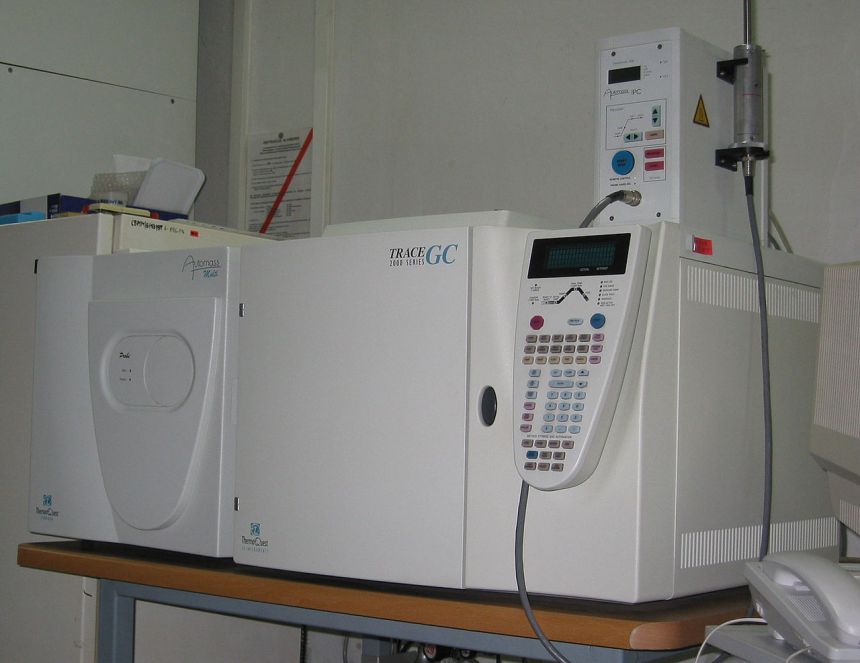
ESR has some fancy scientific equipment that can work out the chemical structure of new drugs and unknown samples more accurately than Fourier Transform InfraRed spectroscopy (FTIR). They use a technique called Gas Chromatography Mass Spectrometry, more commonly known as GCMS. Here’s what happens when your sample is run through GCMS.
Step 1: Gas chromatography
The first step of GCMS is the gas chromatography. Chromatography is a technique used to separate a substance into different components. Gas chromatography, the branch we’re interested in, separates your sample into different chemicals based on how easily they dissolve in a chosen solvent.
First, your sample is vaporised, and then pushed along by helium gas through a long separation column (around 30m!). Some components of your sample will reach the end of the tube before the others, depending on how many interactions they have with the helium gas and sides of the column. This is kinda like a running race – all the runners start together, but they finish at different times.
Step 2: Mass spectrometry
Once each component has been separated, they can be fed into the mass spectrometer. A mass spectrometer uses a chemical’s molecular weight to get information. It does this by shooting a beam of electrons (energy!) at a molecule, splitting the molecule into charged fragments called ions.
The ions are then passed through a magnetic field that bends the ions’ paths different amounts depending on their mass. The ions then hit a detector and can be built up into a spectrum.
Imagine building a tower out of lego, then knocking it over and weighing all the pieces to work out what kind of tower you built. That’s kinda how mass spectrometry works.

How is GCMS different from FTIR?
Each technique looks at a different characteristic of a substance. FTIR examines the vibrations of bonds in a molecule, whilst GCMS looks at different fragments of a molecule when it’s broken apart. That’s the theory side of things, but there are practical differences, too.
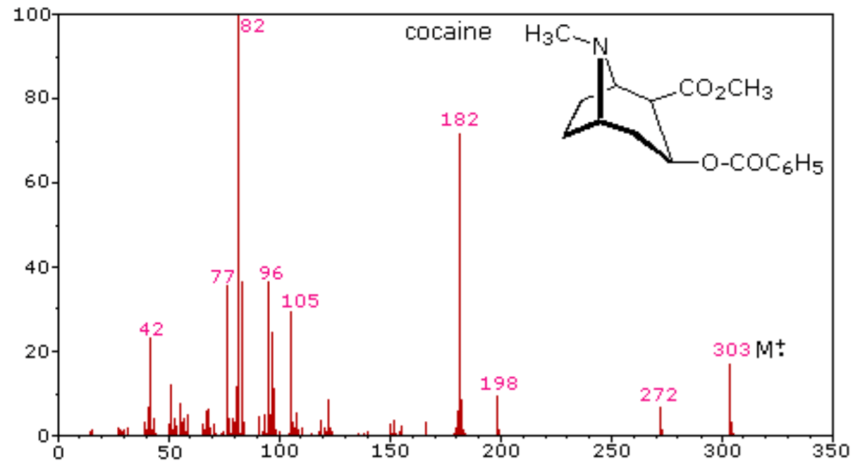
Mass spectrum of cocaine. Each peak represents a different fragment of the molecule. Image retrieved from Chemistry Libretexts.
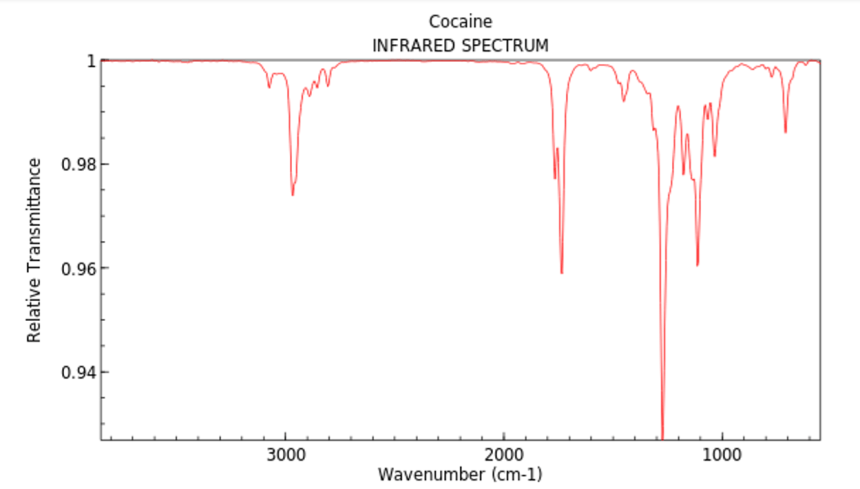
Cocaine FTIR spectrum. Each peak represents vibrations of a different chemical bond.
GCMS vs. FTIR in the field
GCMS is more delicate than an FTIR, and needs more technical training to operate, making it a pain to do in the field. So, not a great option for a festival in the middle of nowhere with unpredictable weather. They also are eye-wateringly expensive. A brand new GCMS will set you back at least a hundred thousand New Zealand dollars, whilst an FTIR is (slightly) more affordable.
There are other reasons why FTIR is better suited to festivals. It’s a non-destructive technique, so if we get an unusual sample we can run further testing such as reagents. Once something has been run through GCMS you can’t get it back because the sample has been separated into its different components.
There’s good news, though – GCMS only needs a tiny sample, smaller than FTIR. We’ve sent ESR bags of dusty residue, and it’s still enough to get a result, however if we send a bigger sample, ESR can do more tests with it if they need to.
Thanks to Olivia and the team at ESR for helping with this post, and, well, everything else, really <3
Further reading and more information
Websites
ESR’s website.
MBIE page about Crown Research Institutes
Gas Chromatography – Libre Texts
Articles
Portable gas chromatography-mass spectrometry in drug checking: detection of carfentanil and etizolam in expected opioid samples. Godzialski, et al., International Journal of Drug Policy, 2021.
Wastewater-based epidemiology to investigate spatio-temporal trends in Alcohol consumption in Aotearoa, New Zealand., Wilson et al. Chemistry: An Asian Journal, 2024.
Podcasts
Our Changing World episode on wastewater epidemiology at ESR – RNZ
Reports
ESR’s 2024 annual report – Page 20 has information on drug checking