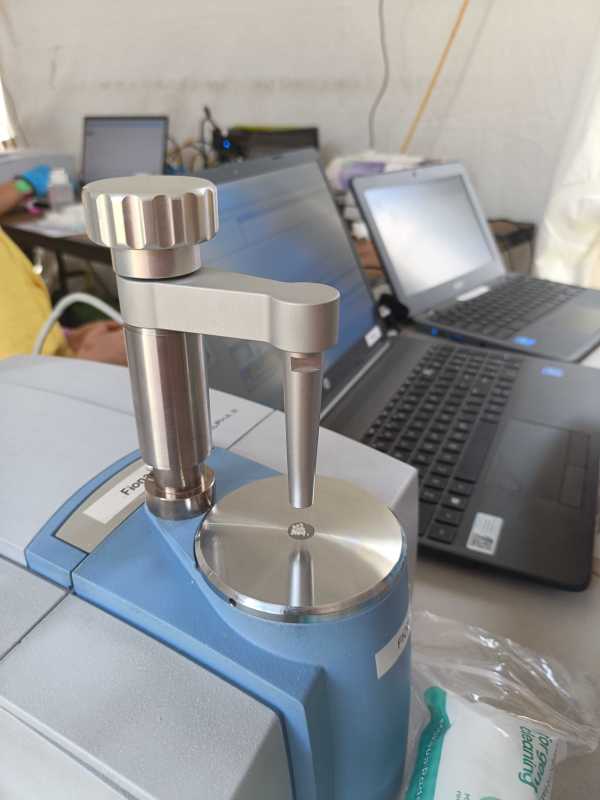
You’ve probably heard us say that we test your substances using a Fourier Transform Infrared Spectroscopy (FTIR) spectrometer. But what does that mean, really?
Let’s say you bring in a sample to us, DISC, or the NZ Drug Foundation. We take a smidgen and put it on the FTIR spectrometer.
FTIR spectrometers, or “specs” for short, work by examining how the molecules of your sample wiggle. The spec works on a very small scale. All molecules are constantly moving, including those in your sample. The bonds between atoms stretch, bend and compress because they have kinetic energy, the energy of movement.
Different molecules vibrate differently, and by scanning the thousands of molecules wiggling, they can take an average and send it to a computer. The computer then displays a picture of the wiggles, called a spectrum, which shows what kinds of molecules your sample is.
We have a massive library of reference spectra, and the spec compares the sample to entries in our library, and pulls up the closest matches called “hits”. Next to the hit, it pulls up a “confidence level”, which is how certain the spectrometer is that your substance’s spectrum matches the reference. This is measured out of a thousand, but getting a confidence level of 993 for ketamine does not mean your sample is 99.3% ketamine. It just means that the spectrometer is pretty certain that your sample is ketamine. This is why we don’t give the confidence level out to clients, as the number can be misunderstood.

Exact science is not always an exact science
There are a few shortcomings with this approach. The main ones we have are:
New molecules and novel substances
If you bring in a brand spanking new molecule that isn’t in our library, the spec will have a tantrum and pull up random compounds. This happened a couple of months ago, when a new ketamine analogue was brought into the clinic, and the spec came back with a very low hit for DMT. Volunteers can tell when this occurs, and generally will ask to send some of your substance away to ESR, who have much more sophisticated equipment and aren’t doing their checking in the middle of a field.
Once the sample has been identified by ESR there are some options for being able to detect it again. Often this means ordering a reference sample from overseas – essentially a lab manufactured, high-purity sample of the drug to build the new spectra. Our libraries are constantly being updated as the drug market changes.
Substances that are potent in low quantities
Another challenge is if you bring in a sample which has the active drug at very low quantities, like LSD.
FTIR spectrometers have a hard time detecting substances that are present at less than 10% of a sample. So anything that is effective at a microgram level is going to be really hard to detect. Unlike MDMA, ketamine and cocaine which the spec can see easily, an LSD dose is in the micrograms, not milligrams. Plus, acid is generally on a tab, which is paper. So, the spec scans the tab, and comes back with paper because that’s all it can see.
We have reagent tests to check acid with, but for other, more high-risk drugs that are potent at low doses, this proves an issue. Say you have a sample that’s mostly MDMA but has a small amount of a very potent drug, for instance a nitazene. The spec will only pick up the MDMA, but the nitazines in the sample will drastically alter your experience. We can check for nitazines with test strips.
We can help you reduce your risks when taking drugs and give you more information on what might be present, but there will always be some risk.
Chemical purity vs. “purity”
In chemistry, purity has a very specific meaning.
A 100% “pure” substance would contain only one single element or compound (such a gold, or ethanol) and nothing else. This is a pretty tough standard to meet, and generally substances considered pure will be between 95% (for food or pharmaceuticals) to 99.7% (for medicines).
Producing a substance such as ketamine requires a chemical reaction with multiple steps. In these reactions, two or more reagents (the starting chemicals) combine to produce a final product.
With every step in the reaction, an amount of the product (or a small component of it) will be produced, but there will most often be other secondary reactions that produce other compounds, and some amount of the original reagents left over. Refining this to “pure” ketamine would require removing 100% of the other compounds produced in the reaction, which is often not possible.
Generally, for a substance to be “pure”, it needs to have undergone rigorous testing, not just through an IR spectrometer, but through other fancy instruments like NMR (Nuclear Magnetic Resonance) spectroscopy or High Pressure Liquid Chromatography (HPLC). We don’t have access to this type of equipment, so will never be able to tell if your substance is pure.
FTIR spectrometers CAN, however, identify what is present in your sample. Say you bring in a pill that’s half ecstasy, half sugar. The spectrometer will likely pick up on this and spit out MDMA and sucrose as its two highest hits. We can run a mixture analysis for pressed pills, which does give rough ratios of up to three ingredients. But these are to be taken with a beakerful of salt, and we use these percentages to roughly calculate the dosage of a pill, not check for “purity”.
We don’t know exactly how inaccurate these percentages are, but as a starting point we say it could go about 20% in either direction. So a sample that showed as 50% MDMA and 50% sugar could be 30% MDMA and 70% sugar, or 70% MDMA and 30% sugar, or anywhere in between.
Chocolate chip cookie effect
Even if there is a high concentration of your drug of choice in the sample, it does not mean that it’s pure. The spectrometer will be more confident with its hit quality and give higher percentages in the mixture analysis, but we cannot calculate concentration. To do so, we would need the whole bag of your drugs, rather than just the match head-sized sample we take.
This is due to the “chocolate chip cookie effect”, which means that the active drug may be in clumps mixed in with the filler in the sample, rather than distributed evenly throughout. This means that the percentages in the part we test are not representative of the entire sample.
As well as this, different drugs are active at different concentrations. Let’s go back to that acid example. Acid is generally sold at very low concentrations, but this doesn’t make it any less effective.
Street drugs aren’t pure. Sorry.
“Purity” is a lovely buzzword for dealers to use to sell their product. But street drugs will never be pure in the scientific sense. In industries like food and pharmaceuticals, a product must go through a purification process to make sure they’re safe for consumers. There are no such processes or standards for recreational drugs.
This means that manufacturers will do as much, or as little purification as pleases them. And purification is boring. With each purification step some of the target drug will be washed away, reducing their yield, and it takes time. This means that recreational drugs will never be made to the same high standard as, say, the ketamine from a vet-amine. There are probably still precursors (the “ingredients” for the drug) present in the final product.

So, TL;DR, no. Drug checkers cannot verify if your drug is “pure” or not. We simply do not have the equipment to do a full laboratory analysis of your sample. The IR spectrometers we use can only pick up if your sample has been partially or fully substituted with something else. And given the conditions most illicit drugs are manufactured under, it’s unlikely you have a pure product.
So if someone says they’ve had their stuff checked with us, and it’s pure, they are mistaken. Next time you get your drugs checked, try asking these instead of “is my gear pure?”:
“Did you find any fillers in this?”
“Is there anything of concern?”
We can tell you those things.
Further reading
IR Spectroscopy and FTIR Spectroscopy: How an FTIR Spectrometer Works and FTIR Analysis
How an FTIR spectrometer works: this is quite technical, but good if you want an in-depth explanation
Limitations and uncertainties of checking fentanyl in British Columbia where they DO have the tools to get concentration (paper spray mass spectrometry)
Beyond a spec: assessing heterogeneity in the unregulated opioid supply
Comparison of IR spectroscopy to other drug checking techniques – note that they mention it cannot be used to quantitatively analyse drugs
An overview of forensic drug testing methods and their suitability for harm reduction point-of-care services