
66-year old Paul “Gandalf” Smith was arrested for cannabis-related charges in February this year. For decades, he’s been part of the Green Fairy network that supplies medical cannabis to people who can’t afford private cannabis prescriptions.
According to an anonymous ex-police officer, the Police in the Far North have known about Gandalf for almost as long as he’s been a Green Fairy, but looked the other way. He’s never hidden what he does.
He’s registered with Inland Revenue and has been paying taxes with ‘Green Fairy’ as his registered business. He’s been on TV talking about his work as a Green Fairy a few times, but most notably on Patrick Gower’s On Weed in 2019, where he goes into detail about the kinds of ailments he treats, how many patients he has, and how the plants he grows help people, all on national TV.
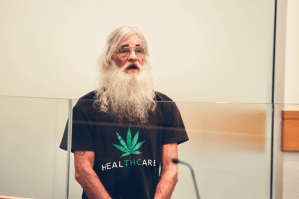
We’re heartbroken about this. The guy’s 66. He doesn’t have any links to violent crime. He hasn’t hurt anyone, either directly or through his products being poor quality or cut with anything. He’s just a regular retiree with a deep interest in growing cannabis so he can help people in need. Now he’s lost his home and his livelihood, and his patients have lost a source of reliable, affordable medical cannabis.
Needless to say, Green Fairy arrests like Gandalf’s are a problem. Patients that can’t access medicinal cannabis through conventional networks rely on the Green Fairies. Every time a Green Fairy is arrested, people suffering from chronic illnesses who need to continue accessing their medicine have to go through the energy-sapping process of finding someone who is
a) Trustworthy, and
b) Knows what they’re doing, medically speaking.
This is super hard work. Not everyone calling themselves a Green Fairy has the knowledge or equipment to make effective medical cannabis products. A study released in 2021 analysed 100 samples from the Green Fairies, and found a wide range of cannabinoid content across the samples, and often claims of high CBD were incorrect.
If a doctor only gives you 12 months to live, the last thing you have time and energy for is playing medical Russian Roulette, and hoping you don’t get arrested in the process.
Read the full analysis of Green Fairy products in Medicinal Cannabis – The Green Fairy Phenomenon by Raymond et al, published in The Australian Journal of Chemistry, 2021
What’s a Green Fairy?
The Green Fairies are an unofficial group of people that grow and distribute cannabis for medicinal purposes on the illicit market. Some are trained herbalists and certified healthcare practitioners. Some have no formal training but have learned from others in the network.
Some of the ailments that Green Fairy cannabis is used to treat include anxiety, pain, sleep issues, and more serious complaints such as epilepsy, migraines, and the side effects of chemotherapy. Some, like Gandalf, grow specific strains that have higher concentrations of either CBD or THC, depending on what their patient needs. Their products range from balms for topical use to tinctures, oils, and plant material.
Read more about illicit medicinal cannabis in Patients experiences of therapeutic cannabis consumption in New Zealand by Hutton, Noller, and McSherry, published in the Journal of Drugs, Habits, and Social Policy, 2023

Wait, medicinal cannabis is legal, so why are Green Fairies still a thing?
While medicinal cannabis has been legal to use since 2010, legal does not mean attainable.
The 2025 New Zealand Drug Trends Survey on medicinal cannabis showed 21% of respondents sourced their cannabis from a cannabis clinic, and 5% said they sourced their cannabis from a pharmacy. By contrast, 24% of participants got their cannabis from drug dealers, 25% sourced their cannabis from friends and family, and 5% used the Green Fairy network.
The process is super expensive
Like most medicines, you need to get a prescription from your doctor to get medicinal cannabis. This means that you have to be able to afford to go to the GP first, which can cost anything between $25 and $90, depending on where you are, if you have a Community Services Card, and how your GP has arranged their fees. Getting a prescription through your GP can also be a multi-visit process, and the costs for that mount up.
You could skip the GP and go straight to a cannabis clinic. So far, these are all privately-operated clinics. So the initial visit with the clinician will cost anywhere between $50 and $100, and generally costs about $50 for the follow-up consultations.
The product is super expensive
Cannabis products aren’t funded by PHARMAC, so they’re not subsidised.
So far we’ve only got two Medsafe-approved medicinal cannabis products that have been assessed by Medsafe and have been approved by the Ministry of Health for distribution as a “medicine”. These are Sativex and Epidyolex. To qualify as a “medicine” under the Medicines Act 1981 a product needs to have been clinically proven under scientifically rigorous conditions to do what it claims to.
There are a number of cannabis products that meet the Ministry of Health’s minimum quality standard that GPs can legally prescribe, but they aren’t considered “medicines”.
PHARMAC is currently reviewing both Sativex and Epidyolex for funding. Sativex currently costs $900+GST, and while we couldn’t find a price for Epidyolex, we’re going to assume it’s similar.
Keep up with PHARMAC’s review process for Sativex and Epidyolex on their website.
There are companies that sell cannabis products that meet the Ministry of Health’s minimum quality standard you can get on prescription, but they aren’t Medsafe approved. This means MedSafe hasn’t assessed the product against the Medicines Act, but they meet the criteria for distribution under Misuse of Drugs (Medicinal Cannabis) Regulations 2019.
These are a bit less expensive, but there’s still the cost of going through a GP referral or approaching a clinic directly. A 30ml bottle of 750mg CBD oil costs between $60 and $80, and THC is apparently cheaper, but it depends on the clinic, or if you’re purchasing from a pharmacy, what their retail margin is.
We can’t speak as to whether or not this is comparable with the illicit market’s prices for refined cannabis products, but the 2024 NZ Drug Trends Survey shows that an ounce of illicitly-sourced cannabis plant costs about $330ish.
You can get funding for medicinal cannabis through ACC, but only for exceptional circumstances.
Not all GPs will prescribe cannabis
Research done by The Royal New Zealand College of General Practitioners in 2023 showed that practitioners that refused to prescribe medical cannabis did so because:
- They did not believe that there was sufficient evidence showing that cannabis was more effective than existing treatments. They also did not believe that cannabis’s risk profile was low enough to choose it over existing treatments.
- Unaffordability of products. Clinicians in lower socio-economic areas were less likely to prescribe medicinal cannabis because it’s too expensive. One clinician said:
“It’s just a cruel and unusual punishment to give a patient a chemical as a trial that they’ll never be able to afford long term” - Non-prescribing clinicians were also concerned about their reputation both among their peers and in the community.
Read the full article on the The Royal New Zealand College of General Practitioners website
It can be hard to trust a GP
We’ve discussed the reasons why doctors might not prescribe cannabis in the above section. In a recent news article the Royal New Zealand College of General Practitioners’ medical director stated he does not believe that cannabis has any evidence showing positive health outcomes and instead focuses on the abuse and addiction aspect.
It’s hard to ask someone in a position of power like a doctor for something that the doctor’s big boss has publicly spoken out against, especially if you’re from a vulnerable community that’s used to being stigmatised against.
We’ve already talked about medical overshadowing and what can happen if you’re open with a doctor about using illicit substances. People are often too scared to ask about getting a prescription for cannabis because they don’t want to be labelled as a drug seeker. That kind of stigma has a lasting effect on how you get treated by the medical system and can be particularly harmful. Sometimes it’s safest not to ask.
Read more about patient overshadowing in Do patients with mental health and substance use conditions experience discrimination and diagnostic overshadowing in primary care in Aotearoa New Zealand? Results from a national online survey by Cunningham et al, Journal of Royal New Zealand College of Practitioners, 2023

Green Fairies are still needed
If patients can’t access medicinal cannabis through legal means, and they’re desperate enough, they’ll use illegal ones.
Strong opioid-based pain relief like morphine and fentanyl for cancer patients have unpleasant side-effects and have a higher addiction risk. Other medications have similar negative side effectss that patients might want to avoid. Patients might also not respond to prescribed medication and have to trial-and-error their way through a number of different medications before throwing up their hands in defeat.
Illicitly-sourced cannabis carries a far higher risk profile in terms of product quality, regularity of supply, and trustworthiness of the source. But if the choice is between breaking the law and continuing to suffer in pain, it’s not really a choice. And what happens to these patients when their Green Fairy is arrested?
Police bust ‘Gandalf’, leaving hundreds without medicinal cannabis – Stuff.co.nz
Russell Brown: Northland green fairy arrest exposes a flawed system – NZ Herald
What’s the way forward then?
Currently under the The Misuse of Drugs (Medicinal Cannabis) Amendment Act 2018 people in under palliative care are allowed access to “illicit” cannabis and the utensils needed to consume it.
This is better than nothing in terms of access to medicinal cannabis, but it has some (massive) holes in it. The one we’re most concerned with is that people aren’t legally allowed to supply illicit cannabis to patients in palliative care. Nor are patients allowed to grow their own cannabis plants.
People in the last year of their life are allowed to have illicit cannabis. But they’re not allowed to get it. This is…counterintuitive at best.
Also, if the patient goes into remission while taking medical cannabis and has longer than 12 months on their mortal clock, their cannabis use becomes criminal again. Remission is not a full cure. Remission happens when the treatment the patient is using starts to work and things start getting better. There is a chance that the patient can backslide and wind up back on the 12-month lifespan.
We think that a couple of tweaks to the Amendment Act would make this bit of legal irrationality go away. These could look like
- Adding a clause to Section 7(3A) to allow growth of cannabis plants for personal use as well as possession of plant materials, oil, etc.
- Adding a clause to Section 8(6A) that would allow people supplying people under palliative care with medicinal cannabis to do so in that specific case.
- Adding another clause to Section 7(3A) to allow people in remission to keep on taking their illicitly-sourced cannabis until they’ve returned to full health.
A stretch goal could be to extend this exemption to any and all patients suffering debilitating conditions that
- Aren’t responding to conventional treatments
- Experience side effects of conventional treatments are outweighing any positives
- Can’t afford the current legal cannabis treatments or are otherwise barred from accessing medical cannabis by location/accessibility
These little legislative tweaks could bring so much relief and help so many people that are suffering needlessly to get back on their feet, Or at least make sure their last days don’t suck.
Much of the legislation already exists, so it won’t be a massive undertaking. If we’re keeping to the palliative ease model, patients already have to prove that they’re dying, so the burden of proof and the governing legislation already exists.
If we aim for the stretch goal of extending the palliative exemption to people who aren’t dying yet, then people will have more options to help with quality of life, help keep them in work, and give them purpose.
It’s just a little tweak. We can do it.