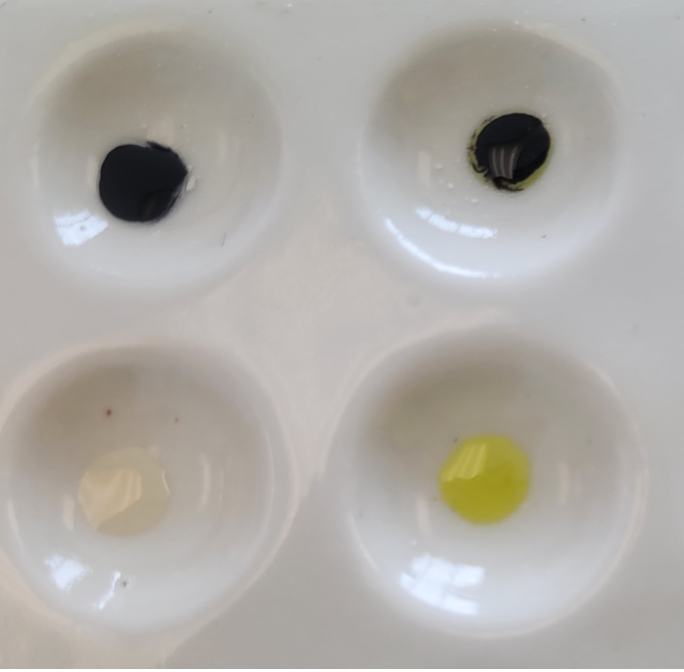
So we have another high risk drug being mis-sold as MDMA this summer. Thanks, we hate it.
Lab analysis has told us that it’s not Alpha-PVP as we first thought, it’s Alpha-D2PV.
Alpha-D2PV is potent enough to have put people in the medics’ tent over New Years’ Eve, so we’re keen to keep things from getting worse.
Because we only have a limited number of spectrometers and volunteers to operate them we can’t be everywhere we need to be, and there will be places where people might find out the hard way that their MDMAybe isn’t what it’s meant to be.
While reagent tests like the ones you buy from Cosmic aren’t going to detect everything in your sample, they’re better than nothing at all. They can only really show you one main ingredient in a sample, so if your stuff does have MDMA in it they can’t tell you if it has anything else harmful mixed in. They can tell you if it’s definitely not MDMA though.
So with that caveat out the way, we’ve compiled a bit of information about the Alpha-P family drugs. There’s a heap of these like Alpha-PVP, Alpha-PHP, Alpha-PPP, and this summer’s high risk drug Alpha-D2PV. Technically they are kinds of cathinones called pyrovalerones.
At the bottom we’ve made a little list of the reagents you can use to help detect Alpha-D2PV and other Alpha-P family drugs, what they should look like, and where you can get them.
Wait, what are the Alpha-D/Alpha-P family drugs?
Alpha-D2PV has only been around since 2020 and there’s little concrete information about it. It’s certainly more potent than MDMA with reported active doses of 20-50 mg. It’s derived from Alpha-PVP, and is in the same drug family as Alpha-PHP.
| Substance | Common dose | High dose | Heavy/high risk dose |
|---|---|---|---|
| MDMA | 80-120mg | 120-150mg | 150mg + |
| Alpha-D2PV | 30-40mg | 40-50mg | 50mg+ |
| Alpha-PHP | 10-25mg | 25-40mg | 40mg+ |
| Alpha-PVP | 5-15mg | 15-25mg | 25mg+ |
When it’s sold as MDMA, and people take a common-sized MDMA-sized dose of 100-120mg, they’re taking multiple doses of Alpha-P or Alpha-D family drugs. This can lead to
- Abnormal heartbeat and heart pain
- Difficulty peeing
- Muscle spasms
- Extreme anxiety and paranoia
- Feelings of impending doom
If they’re taking a high to heavy MDMA-sized dose of 150mg or more then that’s even more risky. This can cause
- Insomnia
- Auditory hallucinations
- Psychosis
- Racing heart
- Seizures
- Unconsciousness
There is also a high risk of serotonin syndrome if you take it while you’re on SSRIs, MAOIs, or taking 5HTP.
Interactions
The Alpha-P and Alpha-D family of cathinones have a higher risk profile when you combine them with other things. If someone thinks they’re taking MDMA and has a fair idea of what else they can take while taking MDMA, they may end up having their day absolutely ruined if what they’re taking is actually Alpha-Pxx or Alpha-Dxxx. As the Alpha-D family of drugs is derived from Alpha-PVP, the interactions with other substances will be roughly the same.
Alcohol
All cathinones are stimulants, just like MDMA. They can stop you from feeling as drunk as you’re getting which makes it easy to drink far too much – and when your stimulant wears off, you can go from 0 to alcohol poisoning in no time at all.
25x-NBOMe and 25xNBOH
These two are highly stimulating and have a heavy body load, putting particular strain on your heart. They’ve been found being sold as LSD this summer. When mixed with an Alpha-family drug (if someone was intending on candyflipping) it can cause psychosis, seizures, and heart failure in extreme cases (please get all of your stuff checked, not just powders or crystals).
Tramadol
Tramadol by itself carries the risk of seizures, and adding stimulant-type substances to the mix can increase that risk.
Read the full list of interactions on Psychonaut Wiki
Using reagents
Like we said earlier, reagents can’t tell if there’s something mixed in with your MDMA. They can only tell if it’s been swapped out completely for something else, either by reacting differently to what you’re expecting, or not reacting at all.
Tips and tricks
- We found that it’s best to use more than one reagent as a cross check. The reagents we’ve listed all react differently if the Alpha-P or Alpha-D family is present, so having multiple reactions is a good way to be more confident in your results, especially if you’re using a reagent that doesn’t react with MDMA.
- The thing about MDMA is that it’s got such a strong reaction it tends to drown out any other reactions happening in your sample, so you won’t be able to see anything other than MDMA.
- It’s best to do reagent tests on a clean ceramic plate that’s either white or a pale colour so you can see the reactions properly. If you plan on doing this more than once, you can get nifty little plates specifically for reagent testing from the Hempstore Aotearoa.
- Put the reagent on the plate FIRST and push the sample into the puddle from the side with a metal spoon, especially if you’re using the bottles from Hempstore. You don’t want to get any of your sample on the nozzle because it’ll contaminate any other samples you want to test in the future.
- Mop up the test residue with a clean cotton pad and wash the plate thoroughly once you’re done.
- Don’t touch the reagents. They’re corrosive as hell and can burn through your clothes and/or leave blisters on your skin, depending on how quick you get to them. Either way it’s completely unpleasant. If you do get some on you, put a little baking soda on the reagent to denature it, then wash it off.
Fantastic reagents and where to find them

Mandelin
Found in the Cosmic EZ test for Ketamine, or at the Hempstore Aotearoa. If there is MDMA in your sample, the reagent will go black, like in the photo.
If Alpha D2PV, Alpha-PHP or Alpha-PVP is present, it’ll go reddish brown in a very short space of time.
Liebermann
Found at the Hempstore Aotearoa. If MDMA is present, it’ll go an intense brownish black instantly.
If Alpha-D2PV is present it’ll go bright yellow. If any of the other Alpha-P family drugs are present, it’ll go a pale yellow.
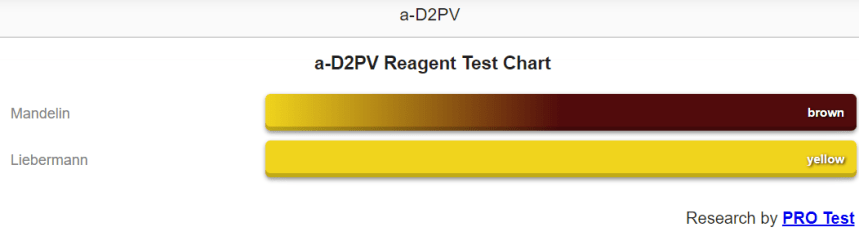
We don’t yet know if Alpha-D2PV behaves differently to other Alpha-P family drugs in other reagent tests but it’s likely pretty similar. We’ve added them below, just in case.
Marquis
Found in the Cosmic EZ test for Ecstasy, or at the Hempstore Aotearoa. If MDMA is present, it’ll go black super quick.
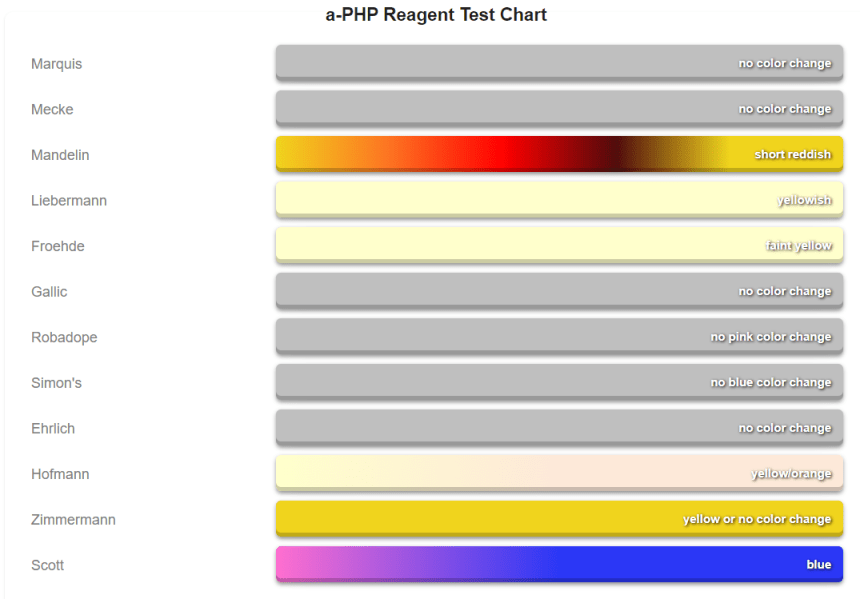
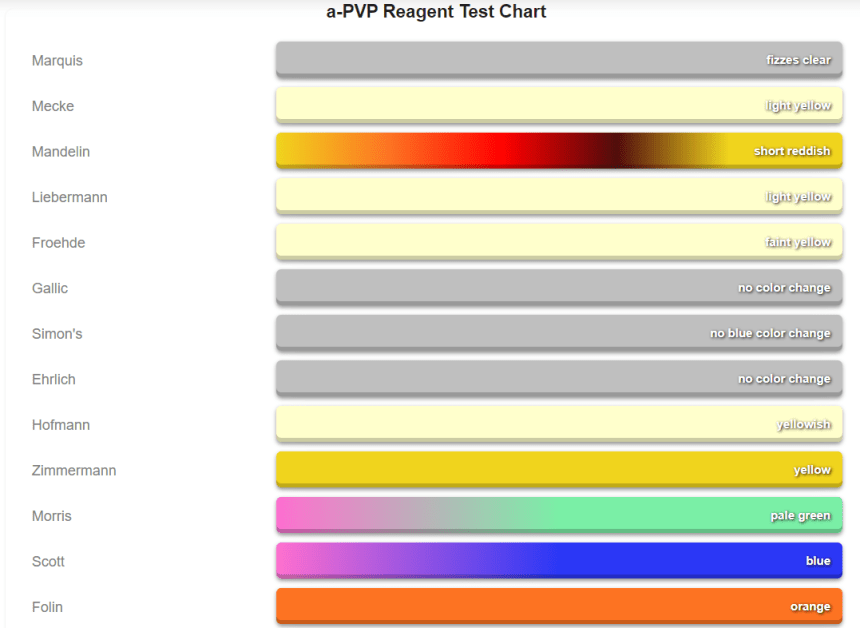
If Alpha-PHP is present there won’t be a colour change. If Alpha-PVP is present, the reagent will go clear and start fizzing. There may also be some smoke, so you’ll want to do this in a well-ventilated area. (Hell yeah, science! But please keep your face away from the science.)
Mecke
Found in the Cosmic EZ test for Opiates, or at the Hempstore Aotearoa. If MDMA is present, it’ll go blue-black instantly.
If Alpha-PHP is present, there won’t be any colour change. If Alpha-PVP is present, it’ll go a pale yellow.
Scott
Found in the Cosmic EZ test for Cocaine. If MDMA is present, there won’t be a colour change.
If Alpha-PHP or Alpha-PVP is present, the reagent will go blue.
There’s a full list of substances and reagent reactions on the PRO Test website. (Which is an awesome site to have a look through if you’re curious about which substances react with what and what the reaction is)
In closing…
An FTIR scan can reveal additional psychoactive substances that have been mixed into a sample so if you can get your gear to a community clinic or come and see us at a festival, please do. Like we said before, reagents aren’t perfect but they are better than nothing at all.
We don’t have the resources to get everywhere that drug checking is needed – none of the drug checking organisations operating at the moment do. Hopefully this will change soon and we’ll get more funding, but until then, we’re doing our best, so please bear with us and reach out if you have any questions about interpreting reagent results.