This is part 2 in our 3-part blog series about the science we use to test your substances.
KnowYourScience Part 1: The FTIR Spectrometer
What are reagent tests?
Reagent tests are tests that change colour when they are added to a certain chemical family. They can tell you about what drugs might be present in a sample.
But reagent tests aren’t just used for checking drugs – some are used to test the presence of sugar, the “hardness” of water (whether it contains a lot of calcium or magnesium), and how acidic or basic a solution is.
Reagent tests often contain toxic or very acidic chemicals, so it’s important to wear gloves when doing these tests and dispose of them properly. To deal with a spill or dispose of leftovers, acids can be neutralised with baking soda.
We’ll sometimes use reagent tests to check what’s in your sample if it’s something our spectrometers struggle with. This is generally when there’s a drug that’s active at very small amounts e.g. LSD, or a very similar group of compounds such as 2C-B/2C-I/2C-E. They can also be used as a secondary or confirmatory test after the spectrometer – more data is (usually) always better!
Reagent tests are good in a pinch if you can’t get to a drug checking clinic, but they have some drawbacks. If you have a mixture of substances in your sample, a reagent test may only pick up the most obvious drug. When using reagent tests, it’s best to use several different reagents and make sure that they all give consistent positives for the drug you purchased.
Different types of reagent tests will react with different parts of a drug molecule. Here are some of the most common ones we use at KnowYourStuffNZ:
Ehrlich’s Reagent
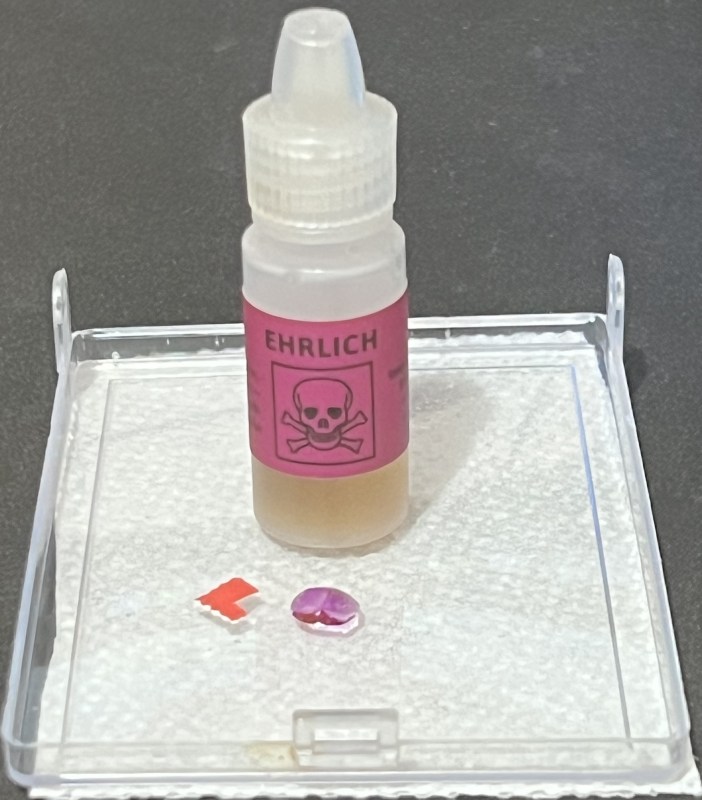
We use Ehrlich’s when we’re looking for indoles like LSD, psilocybin, DMT, and so on. When dropped onto a sample containing an indole the reagent turns purple. It can take a little while to take effect, usually around 60 seconds. Testing tabs has the added complications, like dye bleeding off the paper or the acid in the reagents burning the paper and making the colours look different to what they should.
Also, using Ehrlich’s reagent on mushrooms can be hit or miss. Some non-psychedelic mushrooms have free tryptophan (an indole-containing amino acid) which can trigger a purple reaction, despite there being no psilocybin present.
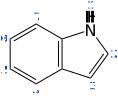
Ehrlich’s reagent is made out of dimethylaminobenzaldehyde (which we’ll call DMAB because what a mouthful), ethanol, and hydrochloric acid. The DMAB reacts with the indole to produce the colour change.
Adding Ehrlich’s reagent to LSD makes it turn purple, but if you added it to NBOMe or NBOH, which are sometimes substituted for acid, it wouldn’t change colour. However, if there was a mixture of LSD and the NBO family of drugs on your tab, you would not be able to tell with just Ehrlich’s reagent. Fortunately, there are other reagents we use that will react with the NBO family, like Marquis.
Marquis Reagent
Unlike Ehrlich’s, which only reacts with indoles, Marquis reacts with a variety of different types of drugs. Marquis reagent will react with NBOMe and instantly turn a brown or yellow colour. It will also change colour in the presence of MDMA (dark purple), 2C-B (green-yellow) and methamphetamine (dark orange). Any reaction after 45 seconds is to be taken with a fairly large chunk of salt.
Marquis reagent isn’t supposed to react with cocaine. But recently, we have seen it sometimes turn a light pink-orange in the presence of cocaine.
We don’t know why this is, but there is probably some sort of precursor or impurity which is reacting with Marquis. There could also be a smidge of methamphetamine in the sample, although this is unlikely as cocaine generally isn’t cut with methamphetamine.
Although Marquis is more versatile than Ehrlich’s or Morris (see below), the ability to react with many types of drugs is not always useful. If, say, a sample was a mixture of N-ethylpentylone and MDMA, the Marquis test would turn the dark colour of an MDMA. The lighter yellow N-ethylpentylone result would be masked by the dark brown MDMA result.
This means that dodgy dealers can make drugs that are mostly N-ethylpentylone, but have a small amount of MDMA in them to give a dark brown Marquis result. An FTIR spectrometer would be able to tell that the sample is mostly N-ethylpentylone, but Marquis reagent alone can’t.
It can also be difficult to see Marquis colour changes if they are subtle or ambiguous. For instance, both 2-CB and cathinones can turn Marquis reagent yellow. So the best way to check drugs is still with a spectrometer.
Mandelin reagent
Similar to Marquis, Mandelin will react with many different drugs including cocaine and methamphetamine. Mandelin reagent is made out of sulfuric acid and ammonium metavanadate, a chemical also used in paints and dyes.
However, a study comparing the efficacy of different reagent tests found that Mandelin reagent was the least reliable because it degraded quickly and did not react to drugs with the expected colour changes. If you are using Mandelin, try to keep it cold to stop it from going off so quickly, and cross-reference wherever possible using other reagents.
Morris reagent
Morris reagent is used to test for ketamine and cocaine. Morris reagent contains two different chemicals which you mix together to get a reaction. The chemicals are cobalt thiocyanate (a salt) and sodium hydroxide (a base).
Morris reagent is different from other reagent tests in this regard, as Ehrlich’s, Marquis, and Mandelin all use acids. The hydroxide, cobalt, and ketamine work together to form a purple colour. But unlike other reagents the two parts do need to be well mixed, which is why you need to stir Morris so all the chemicals can get to know each other.
The precursor to Morris reagent is Scott reagent, which also contains cobalt thiocyanate and is mainly used to test for cocaine. Scott reagent is less accurate than Morris reagent, and gives false positives for other drugs. Scott reagent turns blue in the presence of cocaine, but will also turn blue in the presence of ketamine and fentanyl.
Morris reagent, on the other hand, will only turn purple in the presence of ketamine. However, this does not mean it is infallible, and Morris false positives can still happen with new substances or fillers.
Read more about Morris on the Hempstore website
Limitations of reagent tests
To recap, although reagent tests are useful for checking some drugs, they are much less accurate than the IR spectrometer. Any chemical impurities in the drug can cause the reagent to turn unexpected colours. You also can’t tell when using a reagent test if your stuff is only one drug, or a mixture. Reagent tests also can’t provide dosage information for pressed pills, as they will only indicate the presence of a certain drug.
Beware of testing kits advertising that they can tell you the purity of your substance – these haven’t been scientifically verified and likely won’t do the job.
Reagent tests can also expire as the chemicals in the test degrade. This means that a brand shiny new reagent test is more accurate than one which has been sitting in a cupboard for several years. To keep your reagent tests as accurate as possible, store them in a cool place, mark them with the date that you opened the bottle, and refresh them often. Also, if you’re buying your reagents from a store, check and see how long they’ve been on the shelf — If they’ve been there a while or if the shop’s quite warm the reagent might not be accurate.
Research and further reading
Issue of False Amphetamine Field Test Positives Caused By Sugar. Use of Baeyer Test as a Secondary Test Solution. Knutson et al, University of Nebraska-Lincoln, 2021
Sugar getting false positives for amphetamine with Marquis
Underground pill testing, down under, Camilleri and Caldicott, Forensic Science International, 2005
This one compares reagent tests and mass spectrometry
A review of chemical ‘spot’ tests: A presumptive illicit drug identification technique, Philp and Fu, Drug Testing and Analysis, 2018
This goes into some really interesting history of reagent tests but it’s also vehemently anti-drug. But it goes into what all the different reagent tests are… and what they’re made of. Proceed with caution :/
Fentanyl as a potential false positive with color tests commonly used for presumptive cocaine identification, Kosecki, Brooke, and Canonico; Journal of Forensic Sciences, 2022 About Scott’s reagent – a reagent test that comes back with results consistent with cocaine when the actual drug is fentanyl (Note: we don’t use Scott’s reagent at KnowYourStuffNZ)
Stabilization of formaldehyde into polydimethylsiloxane composite: application to the in situ determination of illicit drugs, Jornet-Martínez, Herráez-Hernández, and Campíns-Falcó; Analytical and Bioanalytical Chemistry, 2019 On improving the Marquis reagent so it doesn’t have so many toxic things in it.
Updates on Dancesafe reagent test reactions
Presumptive testing of amphetamine-type stimulants via colour tests, Pin et al, ASEAN Journal on Science and Technology for Development (AJSTD), 2010 On reagent testing for amphetamine-like substances