In 2021, Aotearoa made history by passing world-first legislation that made drug-checking services explicitly legal. Legal drug checking is a good idea for many reasons, including having a national early warning system for dangerous substances, measurably changing people’s behaviour towards safer practices, and saving lives..
In February, three of Aotearoa’s drug checking organisations hosted a team of researchers from the UK’s University of Bath. Why’s this? Because they wanted to beta-test prototypes of a new drug checking technology, which is hard to do at home. In the UK, drug checking does occur but has been held up by problems with legislation and licensing, making it difficult for researchers to conduct trials like this one. In Aotearoa we have legal protection and a drug-checking sector that has been developing best practice for over nine years.
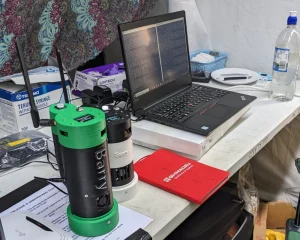
The British team, lead by Professor Chris Pudney, is developing a new portable ultraviolet spectrometer that could be a major advance over the tech we currently use in the field.
It’s portable, affordable, and has the potential to analyse samples that existing spectrometers have trouble with, like the synthetic cannabinoids and nitazenes, which have caused many deaths in the UK and New Zealand. Some of these ‘red flag’ substances, including synthetic opioids such as nitazenes and fentanyl, are toxic in very minute quantities, so being able to detect them is critical to saving lives.
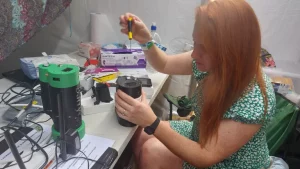
Dr. Rachael Andrews, who led the UK visit, said “it was really eye-opening to see how far drug checking has developed in New Zealand, and witness the positive interactions that were had with clients.”
The University of Bath team worked with all three front-line drug checking services: the Needle Exchange Programme, the New Zealand Drug Foundation, and KnowYourStuffNZ. They joined public clinics in Christchurch and Auckland, and the KYSNZ team at Splore festival to see how the different organisations operate.
Over two weeks, the team had the chance to test their technology on hundreds of New Zealand samples. This will help them to understand how well their prototype instruments compare to the current state of the art kit
Jason George from the Needle Exchange said: “It was great to have the team working with us and great to host them. They have a technology with exciting potential, especially for detecting substances that are hard to detect with infrared spectrometers.”
KnowYourStuffNZ Deputy Manager Dr Jez Weston said “the spectrometers that we use are currently the best tech for mobile drug analysis, but science moves ever on. The University’s new technology could help us help our clients with better and faster analysis of what our clients’ samples are.”
New Zealand’s legalisation and licensing of drug checking makes us a world leader in the growing field of drug checking. The main goal behind the legislation is to reduce the harm from drugs, but an unintended consequence is that others are looking to New Zealand to model their practices on and how they can work with clients and the law.
The benefits of our legal status allows researchers to come and trial their emerging technologies and other innovations, which is great because:
Drug harm reduction gets advanced in new ways because universities and other research bodies can operate more freely. This means more opportunities for innovation, technology, and understanding attitudes and behaviours around drugs
We get to showcase the benefits of drug checking as a sound and legitimate harm reduction tool across the globe, and do some solid mythbusting of misconceptions around the efficacy and effects of drug checking
This technology is in its prototype stage, and is developing rapidly. It’s now being trialled in drug checking clinics in the UK. New technologies take time, for good reason – drug checkers need to have confidence in their results to give people valuable harm reduction advice.
Thanks to the University of Bath research team, the DISC Trust, and the New Zealand Drug Foundation for their involvement in this trial.